

Grade 347 & 347H Stainless Steel Plate
Stainless Metal Grades to Fit Your Needs
347 Stainless Steel Plate
Grade 347 stainless steel is an 18/8 chromium-nickel alloy reinforced by columbium and tantalum. Generally used in the 800-1500°F temperature range, the columbium stabilizes it and makes it immune to carbide precipitation, offering excellent intergranular corrosion and oxidation resistance. It additionally possesses higher creep and rupture properties than 304/304L stainless steel.
347H Stainless Steel Plate
Grade 347H contains more carbon (0.04–0.10% carbon) than regular 347 (≤ 0.08% carbon), which improves the creep properties and strength at temperatures above 1000°F. While it excels in high-temperature conditions, Grade 347 stainless steel plate also demonstrates excellent toughness in cryogenic temperatures.
Sabre Alloys specializes in providing a wide variety of both common and exotic stainless steel plate grades. We carry 347 & 347H plate options in up to 120” in width, up to 3.5” in thickness, and up to 480” in length. Along with 347 & 347H stainless steel plates, Sabre Alloys also provides 347/347H bar.
Note: Ranges vary by mill and specific product form. Contact us for availability on sizes outside standard stocking range.
0.250-3.5″
Thickness
96-240″/480″
Length
96″/120″
Width
Choosing 347/347H Plate from Sabre
While both 347 & 347H stainless steel plate can be hardened only by cold working, they can be easily welded and formed using standard steel processing and fabrication practices.
key advantages and benefits include
- Superior resistance to intergranular corrosion
- High strength, creep, and stress rupture properties
- Excellent performance in extremely high-temperature conditions
- Outstanding welding and forming characteristics
- Good toughness in subzero temperatures
- Non-magnetic in the annealed condition
- Resists oxidation up to 1500°F
Technical Specifications & Properties
Chemical Composition
| Element | 347 | 347H |
| Chromium (Cr) | 17.0-19.0% | 17.0-19.0% |
| Nickel (Ni) | 9.0-13.0% | 9.0-13.0% |
| Carbon (C) | ≤0.08% | 0.04-0.10% |
| Manganese (Mn) | ≤2.0% | ≤2.0% |
| Silicon (Si) | ≤1.0% | ≤1.0% |
| Phosphorus (P) | ≤0.045% | ≤0.045% |
| Sulfur (S) | ≤0.030% | ≤0.030% |
| Niobium + Tantalum (Nb+Ta) | 10×C min – 1.0% max | 10×C min – 1.0% max |
| Iron (Fe) | Balance | Balance |
Note: The combined niobium and tantalum content must be at least ten times the carbon content, up to a maximum of 1.0%
High-Temperature Performance
- Maximum service temperature: Resists oxidation up to 1500°F (816°C) and has higher creep and stress rupture properties than 304/304L
- Stabilization range: Typically used in the 800-1500°F (427-816°C) temperature range, where it is stabilized against chromium carbide precipitation by the addition of niobium
- 347H advantage:
- Offers improved creep strength above 1000°F (537°C)
- Suitable for continuous service up to approximately 1500°F (816°C), with intermittent exposure possible at higher temperatures depending on application design
- At high temperatures, 347H is more durable than other stainless steel materials and can maintain its strength and durability without embrittlement or fatigue
Corrosion Resistance
347 stainless steel exhibits good general corrosion resistance that is comparable to 304:
- Intergranular corrosion: Excellent resistance to intergranular corrosion after exposure to temperatures in the chromium carbide precipitation range of 800–1500°F (427–816°C)
- Oxidizing environments: Good general corrosion resistance and somewhat better resistance in strong oxidizing conditions than 321
- Chemical resistance: Performs well in nitric acid, diluted organic acids, phosphoric acid (cold and up to 10% at high temps), and polythionic acid environments
- Limitations: Does not perform well in chloride solutions, even in small concentrations, or in sulfuric acid
Fabrication & Welding Characteristics
- Welding: Excellent weldability and is suitable for the full range of conventional welding methods (like MMA, MIG, TIG), except gas welding
- Post-weld treatment: Generally not required due to niobium stabilization, but may be considered in severe cyclic high-temperature applications
- Heat Treatment: Can be annealed at temperatures ranging from 1850 to 2000°F (1010 to 1193°C) and then quenched with water
- Cold Working: The hardness and strength of the steel can be increased through cold working
- Hot Working: Forging, upsetting, and other hot work processes can be performed at 2100 to 2250°F (1149 to 1232°C)
347 & 347H Stainless Steel Processing Services
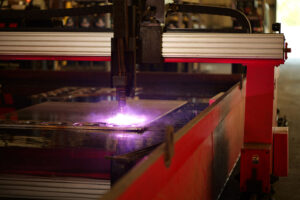
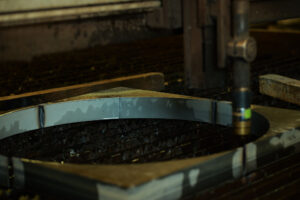
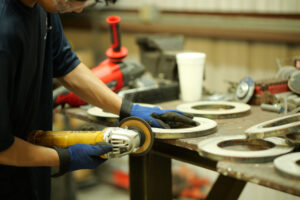
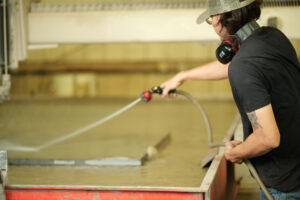
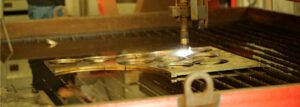
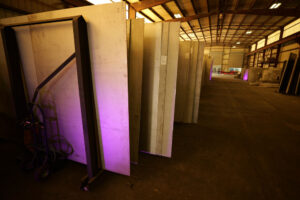
In conjunction with our extensive material stock, Sabre Alloys offers various stainless steel processing services to meet our customers’ material requirements. Our value-added stainless steel services allow us to meet exact specifications with short turnaround times.
Sabre Alloys offers the following value-added 347 and 347H stainless steel plate processing services:
Grade 347 and 347H Stainless Steel Plate Applications
Grade 347 is recommended for welding applications that cannot be post-annealed. Because it can operate at high temperatures without losing strength, both 347 grades are ideal for welding equipment, furnace and boiler elements, heaters, high-pressure steam pipes, aircraft parts, and chemical-processing equipment.
Sabre Alloys streamlines our customers’ Grade 347 and 347H stainless steel plate supply chain in numerous industries by reducing the lead time associated with stainless steel acquisition and processing. View All Industries to see a comprehensive list of our applications.
industries served
- Water
- Food processing
- Environmental
- Architecture
- Appliances
- Pharmaceutical
Contact Sabre Alloys
As a full-service stainless steel distributor, Sabre Alloys prides itself on getting you the steel you need, exactly how and when you need it. Let us help you save time and money with our high-quality ASTM A240 Grade 347 and 347H stainless steel plate and processing services.
For more information about our Grade 347 and 347H plate products, please Contact Our Team at Sabre Alloys today.
Your Quality Supplier & Distributor of Strong, Corrosion & Heat-Resistant Grades
Whether you need material for a new product application or you want to replace your existing supply, let our talented staff at Sabre Alloys be your partners for sourcing exotic, high-quality stainless steel. Request a quote today.
need assistance?
Use Our Weight Calculator
Use our calculator to find the right grade for you.
Frequently Asked Questions
Can you heat treat 347/347H Stainless Steel?
347/347H cannot be hardened through heat treatment like martensitic stainless steels. The only heat treatments applicable are:
- Solution annealing: Heat to 1850 – 2000°F (1010 – 1093°C) followed by rapid water quenching to dissolve carbides and restore corrosion resistance
- Stabilization treatment: Heat to 1550 – 1650°F (845 – 900°C) for up to 4 hours to fully precipitate niobium carbides, maximizing resistance to intergranular corrosion
- Stress relieving: Can be performed at 800 – 1500°F (427 – 816°C), though this is typically unnecessary due to the stabilization from niobium
Strengthening can only be achieved through cold working, not heat treatment.
What is the difference between 347 & 321 stainless steel for high-temperature applications?
While both are stabilized austenitic grades, 347 offers several advantages:
- Better high-temperature strength: The niobium stabilization in 347 provides superior creep and stress rupture properties compared to titanium-stabilized 321
- Corrosion resistance: 347 typically provides comparable or slightly improved performance in strongly oxidizing environments compared to 321.
- Better polishability: Niobium carbides are finer than titanium carbides, allowing 347 to achieve a better surface finish
- No titanium loss: Unlike 321, which can lose titanium during welding, 347’s niobium remains stable through multiple thermal cycles
The main advantage of 321 is that it shows improved resistance to polythionic acid stress corrosion cracking compared to non-stabilized grades when properly heat-treated.
How does welding 347 plate compare to 304, and what filler metal should I use?
While both are stabilized austenitic grades, 347 offers several advantages:
- Filler selection: Use ER347 filler metal to maintain stabilization; never use 308/308L, as this defeats the purpose of the niobium stabilization
- No post-weld heat treatment required: Unlike 304, the niobium in 347 prevents sensitization, eliminating the need for post-weld annealing in most cases
- Slightly higher heat input acceptable: The stabilization allows for slower travel speeds without sensitization concerns
- Better for multi-pass welds: Can handle repeated thermal cycles better than 304
- Slag removal: Niobium can create a slightly more tenacious slag that requires more aggressive cleaning
Similar Steel Plate Products
Sabre Alloys aims to be your solution center for exotic, high-quality stainless steel plate. We offer hard-to-find metal grades and we cater to a wide range of industries.